When the Insurance Company Becomes the Second Injury
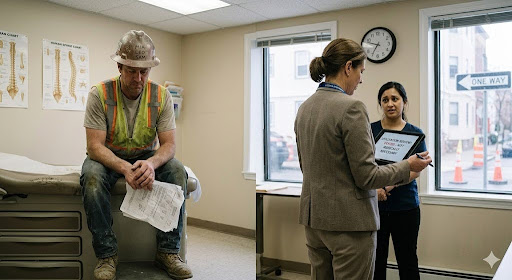
There’s a moment I remember clearly from my years managing construction claims. A framer—good worker, mid-forties, three kids—called me from his truck outside a clinic. He’d just been told by the claims adjuster that his MRI wasn’t “medically necessary” yet. His treating doctor had ordered it two weeks prior. He wasn’t angry on the phone. He was quiet in that way people get when they’ve been worn down to something close to defeat. “Am I crazy,” he asked me, “or is this just how it works?”
He wasn’t crazy. And yes, in a lot of ways, that’s exactly how it works.
I spent years inside the workers’ compensation system handling construction claims—watching how insurance companies, employers, and medical management firms interact with injured workers. Now I write about it because I keep seeing the same conversations online, late at night, from workers in Boston and across the state asking the same questions that framer asked me. You’re not imagining the delays. You’re not being dramatic about the pressure. And you’re not alone in feeling like the process was designed for someone else’s benefit.
How a Claim Actually Moves—Step by Step
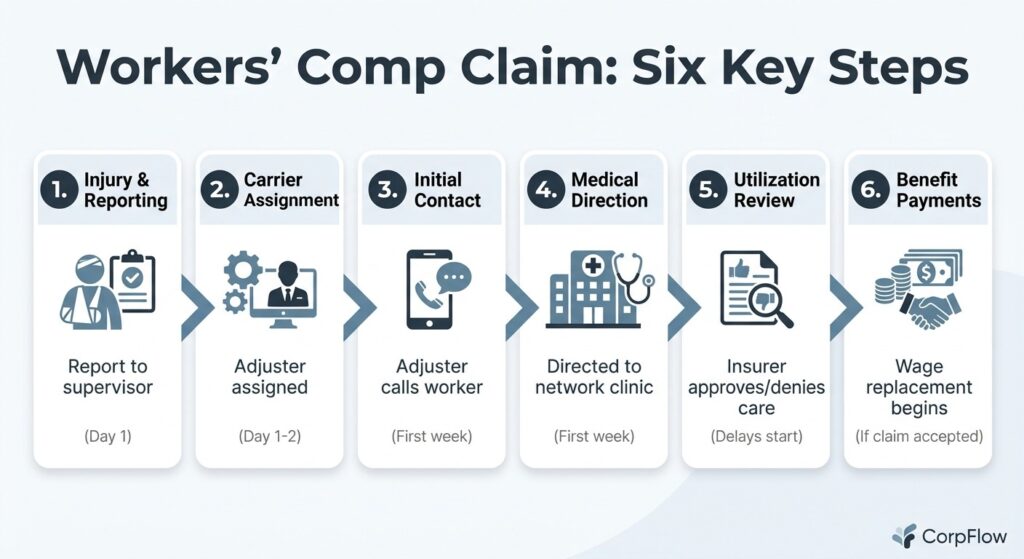
Most workers assume that once they report an injury and see a doctor, the system takes care of the rest. That’s the first misunderstanding, and it costs people.
Here’s what actually happens:
| Stage | What Occurs | What to Watch For |
|---|---|---|
| Injury & Reporting | You report to your supervisor—ideally same day | Late reporting is one of the first things adjusters flag |
| Carrier Assignment | Employer notifies insurer; adjuster is assigned | That adjuster works for the insurer, not for you |
| Initial Contact | Adjuster calls, sounds helpful, asks about the accident | Some questions are routine; some build a case against you |
| Medical Direction | Employer directs you to a network clinic | Legal in many states for an initial period |
| Utilization Review | Insurer’s team evaluates whether treatment is “medically necessary” | This is where delays begin—your doctor orders an MRI; UR says not yet |
| Benefit Payments | Wage replacement starts if claim is accepted | Watch for a “reservation of rights” letter—it matters |
That “reservation of rights” letter deserves special attention. It means the carrier is paying for now but explicitly reserving the right to deny later. If you receive one, treat it as a signal that your claim is already being contested, even if no one has said so directly.
The IME: When the Insurer Gets Its Own Doctor
This is the part of the process that confuses and frustrates workers more than almost anything else.
At some point—often when your treating doctor says you’re not ready to return to full duty—the insurance company will schedule you for an Independent Medical Examination. The name is misleading. The IME physician is hired and paid by the insurer.
That doesn’t mean every IME is rigged. But it does mean the exam serves a specific function: to give the carrier a second medical opinion that may contradict your treating doctor’s findings. IME doctors often spend 15 to 30 minutes with a patient and then produce a report saying the worker has reached “maximum medical improvement” or can return to modified duty. Your treating physician, who has seen you over months, may strongly disagree.
When those opinions conflict, the insurer often uses the IME report to cut off or reduce benefits. This is legal. It’s also one of the most common pressure points in construction injury claims involving back injuries, shoulder tears, and knee damage—exactly the kinds of injuries that take real time to heal. NIOSH construction ergonomics research has consistently found that re-injury risk is highest when physical demands are restored before strength and range of motion have fully returned. An IME that clears you for work too early isn’t just a paperwork problem—it’s a health risk.
What you can do: Request a copy of the IME report. Have your treating doctor respond to it in writing. Document everything. In many states, you have the right to challenge the IME findings through a formal process. In California, for example, treatment denial challenge options allow workers to request an Independent Medical Review when treatment is denied or modified—a path that’s often missed entirely because no one tells workers it exists.
The Tactics That Slow Claims Down
Insurance companies are not monolithic villains. They are, however, businesses with financial incentives to minimize payouts—and claims adjusters work within systems that reward cost containment. That creates predictable patterns. Here’s the playbook, named plainly:
1. Delay as a strategy. When liability is unclear or injury severity is disputed, carriers slow the process—requesting additional documentation, scheduling IMEs weeks out, or issuing partial denials while “investigating.” The longer a claim drags, the more likely a financially stressed worker is to accept a lower settlement.
2. Disputing causation. Adjusters look for any prior injury, prior treatment, or prior complaint related to the same body part. A worker who saw a chiropractor for back pain two years ago may suddenly find that their herniated disc from a fall is being called “pre-existing.” This is one of the most common tactics in construction claims, where physical wear is simply part of the job.
3. Return-to-work pressure. Subtle, and it often comes from the employer and insurer simultaneously. You’ll get calls asking when you think you’ll be back. You might hear that “light duty” is available—sometimes it genuinely is, sometimes it’s a position that doesn’t actually accommodate your restrictions. If you refuse a light duty offer that your doctor says is appropriate, your benefits can be reduced or stopped.
4. Surveillance. Yes, it happens. Insurers hire investigators to photograph or video claimants doing activities that appear inconsistent with their claimed limitations. A worker who can’t lift at work but carries groceries from the car can find that footage in a hearing file.
Knowing the playbook doesn’t mean you’re paranoid. It means you’re paying attention.
What You Can Actually Do About It
Workers’ compensation is a state-specific system with real procedural rules. The right move depends on where you are and what stage your claim is in. But some steps matter everywhere.
Document everything from day one. Write down the date, time, and circumstances of your injury. Keep a log of every phone call with the adjuster—date, who called, what was said. Save every letter, every denial, every form. This documentation is your evidence if the claim is ever disputed at a hearing.
Don’t give recorded statements without understanding your rights. Adjusters sometimes request recorded statements early in the claim. You may be required to cooperate, but you’re not required to do so without preparation. Know what you’re going to say and stick to the facts.
Respond to retaliation quickly. If your employer starts cutting your hours, changing your assignments, or making your work life difficult after you filed a claim, that may be illegal retaliation. OSHA’s whistleblower protections cover construction workers under Section 11(c)—but the deadline to file a retaliation complaint is just 30 days in many cases. That window closes fast.
Know your appeal rights. Denial isn’t the end. In New York, for example, most Board decisions can be appealed using Form RB-89 within 30 days of the decision’s filing date. Missing that window can mean losing your right to challenge the decision entirely.
Talk to an attorney before you assume you don’t need one. Workers’ comp attorneys in most states work on contingency—they don’t get paid unless you do. A consultation costs nothing and can tell you quickly whether your claim is being handled fairly or whether something is off. If you’re in the Boston area and dealing with a construction injury that’s gone sideways, speaking with construction accident attorneys in Boston can help you understand what your specific situation actually looks like under Massachusetts law.
Quick Diagnostic: Has Your Claim Gone Off the Rails?
There’s a difference between a claim that’s moving slowly because the system is slow, and a claim that’s being actively managed against you. The first is frustrating. The second requires action.
Ask yourself these questions:
- Is your treating doctor’s recommendations being routinely overridden by utilization review?
- Did your benefits get cut shortly after an IME?
- Are you getting pressure from your employer and the adjuster in the same week?
- Has your adjuster stopped returning calls?
- Have you received a settlement offer before reaching maximum medical improvement?
One “yes” might be coincidence. Two or more is a pattern worth taking seriously. A claim where you’re being pushed back to work before you’re ready—where your doctor’s opinion is being dismissed, where the checks are inconsistent—that’s not bureaucratic slowness. That’s a contested claim, and it calls for a different response than patience.
A Few Resources Worth Bookmarking
Your state workers’ compensation board website is the first place to look for your specific rights, deadlines, and forms. OSHA’s site covers retaliation protections. If you’re in a union, your rep may have navigated these exact situations before and can be a faster resource than you’d expect. And if the claim has become a fight, a workers’ comp attorney who handles construction cases is often the most efficient way to level the playing field.
The framer I mentioned at the start eventually got his MRI. It showed a significant disc injury. He got the treatment he needed—but only after his attorney pushed back on the IME report. He lost about four months of proper treatment to the delay.
Four months he can’t get back.
You shouldn’t have to fight this hard. But knowing the system means you’re not fighting blind.