
The Rules Are Different Here — What Massachusetts Law Actually Means for Your Claim
The Rules Are Different Here — What Massachusetts Law Actually Means for Your Claim
Most people who contact me after an injury have already made at least one mistake they didn’t know was a mistake. Not a catastrophic one, usually. But they’ve given a recorded statement to an adjuster. Or they’ve waited six weeks to see a doctor because the pain “wasn’t that bad.” Or they genuinely believed the clock on their claim didn’t start until they hired a lawyer.
That last one is the most common. And it’s the one I want to address first.
What “Filing a Claim” Actually Means in Massachusetts
Here’s the confusion I see constantly in online forums and comment threads: people use “filing a claim” to mean one thing when Massachusetts procedure means something else entirely. They think it starts with a lawyer. Or a courthouse. Or at least a formal document with their name on it.
The process actually branches early—and both branches have their own timelines and consequences.
| Branch | What It Involves | Key Consequence of Delay |
|---|---|---|
| Insurance Claim | Reporting to your own insurer; notifying the other party’s carrier | Policy cooperation clauses can be triggered; coverage complications arise |
| Civil Lawsuit | Filing a Complaint as plaintiff in Massachusetts court | Missing the statute of limitations ends your case permanently |
If you were injured in a car accident, Massachusetts requires you to report the incident to your own insurer promptly. This isn’t optional, and it isn’t just a courtesy call. Your policy almost certainly contains a cooperation clause, and failing to report in a reasonable timeframe can give the insurer grounds to complicate your coverage. The same principle applies to a slip-and-fall on commercial property—notifying the property owner or their insurer creates a paper trail that matters later.
The civil lawsuit branch is where formal legal process begins: you, as the plaintiff, filing a Complaint against the defendant in the appropriate Massachusetts court. As a personal injury lawyer massachusetts would explain during an initial consultation, for claims exceeding $50,000, the Massachusetts Superior Court has original jurisdiction over civil actions over $50,000 — smaller claims may land in District Court or Small Claims Court depending on the amount in dispute.
These two branches aren’t mutually exclusive. Many claims involve both: an insurance negotiation that fails, followed by a lawsuit. Understanding that distinction early prevents a lot of paralysis.
The Deadline That Cannot Be Negotiated
Massachusetts General Laws Chapter 260, Section 2A is not a suggestion.
Most personal injury lawsuits must be filed within three years of the injury date. Miss that window, and the defendant’s attorney will file a motion to dismiss. The court will grant it. Your case ends there, regardless of how strong it was on the merits.
Three years sounds like a long time until you account for what actually happens inside those three years. Medical treatment takes months. Disputes with insurance companies drag on. People assume they have time. Then a year passes, then two, and suddenly the attorney they finally consult is telling them the window is closing.
A note on exceptions: The discovery rule can extend the clock if an injury wasn’t immediately apparent, and minors have additional protections. But counting on exceptions is a bad strategy. Treat the injury date as the start of a countdown.
What “acting accordingly” looks like in practice: document everything from day one, seek medical attention promptly, report to your insurer, and consult with a personal injury attorney well before the three-year mark. Not in month 34. Well before.
The Four Elements You Have to Prove
Before getting into the step-by-step mechanics, it helps to understand what you’re actually building toward. Massachusetts General Laws Chapter 231 governs civil liability, and a valid personal injury claim requires proving four elements:
- Duty of care — the defendant owed you a legal duty
- Breach — they failed to meet that duty
- Causation — that failure caused your injury
- Actual damages — you suffered real, quantifiable harm
Every piece of documentation you collect from the moment of injury is building toward one or more of these. The police report establishes facts about the incident. Medical records connect the incident to your injuries. Bills and lost wages quantify your damages. Photographs and witness statements support breach.
This is why I tell people not to wait until they’re “sure” they have a case before starting to document. You don’t know yet what your case is. You’re gathering the raw material that a personal injury attorney will later use to assess it. Collecting that material costs you nothing. Failing to collect it can cost you everything.
The Practical Sequence: What to Do and When
Think of the first weeks after an injury as a documentation sprint. The sequence matters.
First: Get medical attention, even if you feel “okay.” Adrenaline masks pain. Soft tissue injuries, concussions, and internal trauma don’t always announce themselves immediately. More importantly, a gap between the injury date and your first medical visit gives insurers an opening to argue your injuries weren’t caused by the incident. Same-day or next-day treatment creates a clean evidentiary record.
Second: Document the scene and preserve evidence. Photographs of the accident location, your injuries, vehicle damage, hazardous conditions—take them immediately if you can, or return to the scene within hours if you couldn’t. Write down what happened in your own words while the details are fresh. Get names and contact information from any witnesses.
Third: Report to your insurer. Contact your insurance company promptly. Be factual. Describe what happened without speculating about fault or minimizing your injuries.
Fourth: Do not give a recorded statement to the other party’s insurer. The other driver’s insurance company, the property owner’s liability carrier—they will call, often within 24 to 48 hours, and they will sound helpful. They are not your insurer. You have no obligation to give them a recorded statement, and doing so before you understand the full extent of your injuries is a mistake. Anything you say will be used to limit your damages.
Fifth: Consult a personal injury attorney before settling anything. Most Massachusetts personal injury attorneys offer free initial consultations. Bring what you have: medical records and bills, police or incident reports, photographs, witness information, insurance policy details, and any correspondence you’ve already received. That consultation will tell you whether you have a viable claim, what it might be worth, and what the next steps look like.
How Comparative Fault Can Reduce What You Recover
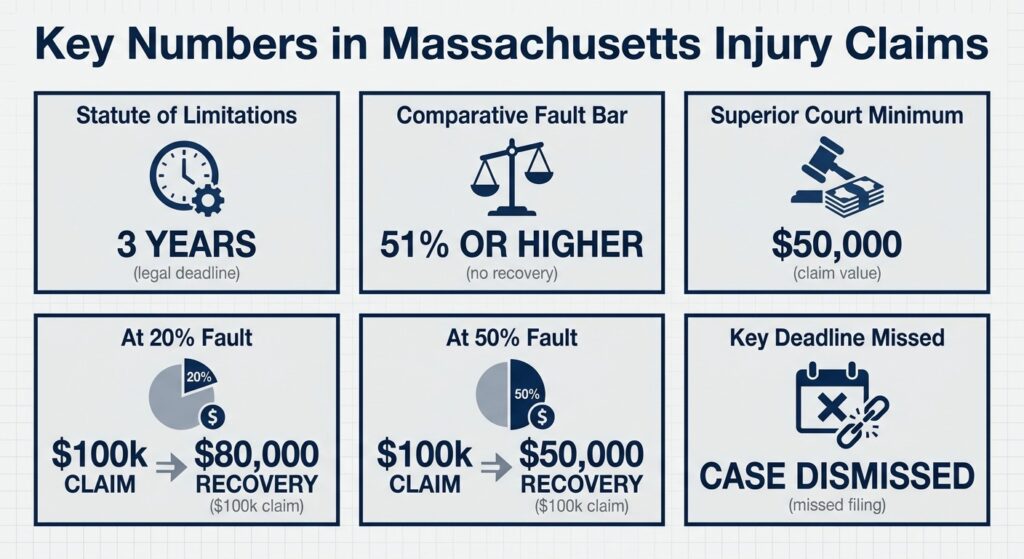
Massachusetts follows a modified comparative negligence rule codified in Massachusetts General Laws Chapter 231, Section 85 — damages are reduced in proportion to the plaintiff’s share of fault, and recovery is barred entirely if that share exceeds the total negligence of the defendant.
Here’s how the math works:
- Your damages are reduced by your percentage of fault
- At 20% fault on a $100,000 claim → you recover $80,000
- At 50% fault on a $100,000 claim → you recover $50,000
- At 51% fault or higher → you recover nothing
That last line is the one people don’t see coming. Massachusetts uses a 51% bar: if you’re found more than 50% at fault, the claim is extinguished entirely.
Insurance adjusters know this rule well, and they will look for ways to assign you a higher percentage of fault—a recorded statement where you said you “weren’t paying close attention,” a delay in medical treatment that suggests the injury wasn’t serious, a prior condition they can argue was the real cause. Each of these becomes leverage to reduce your damages or deny your claim entirely.
The practical implication: be careful about what you say, to whom, and when. This isn’t about being deceptive. It’s about not inadvertently handing the other side ammunition before you understand how fault will be allocated.
What Damages Are Actually Recoverable
Damages in Massachusetts personal injury cases fall into two broad categories:
Economic damages — the concrete financial losses:
- Medical bills (past and future)
- Lost wages
- Reduced earning capacity
- Cost of ongoing treatment
Non-economic damages — harder to quantify, but equally real:
- Pain and suffering
- Emotional distress
- Loss of enjoyment of life
Both are recoverable. Non-economic damages, however, are more susceptible to dispute—which is one reason having documented medical treatment and a clear injury timeline matters so much.
When Things Get Complicated
Two situations come up repeatedly that deserve direct attention.
You’ve already spoken to an adjuster and said something you’re now worried about. Don’t assume the claim is over. What you said matters, but context matters too. An experienced personal injury attorney can often work around early statements, especially if your medical records tell a consistent story. The mistake is compounding the problem by continuing to talk without guidance.
The injury involves a government entity. A pothole on a city street. A fall in a public building. A collision with a municipal vehicle. Massachusetts has specific notice requirements for claims against government defendants, and the timelines are shorter than the standard three-year statute of limitations. If a government entity is involved, the urgency to consult an attorney increases significantly—this is not a situation where you have the luxury of waiting to see how you feel in a few weeks.
Quick Reference: Common Mistakes and What They Cost You
| Mistake | Why It Hurts Your Claim |
|---|---|
| Delaying medical treatment | Creates a gap insurers use to dispute causation |
| Giving a recorded statement too early | Locks you into descriptions before you know your full injuries |
| Waiting until month 34 to consult an attorney | Leaves no buffer if complications arise near the deadline |
| Assuming the other insurer is neutral | They are working to minimize your payout, not help you |
| Failing to document the scene | Loses evidence that may be impossible to recreate |
Where to Start Right Now
If you’ve read this far, you’re already doing the right thing—trying to understand the process before you make a move you can’t take back.
The next step is concrete. Gather whatever documentation you have. Write down a timeline of events while your memory is clear. Schedule a consultation with a Massachusetts personal injury attorney. You don’t need to know whether you have a case yet—that’s what the consultation is for.
What you do need to know: the three-year clock is running, the insurance companies on the other side are not neutral parties, and the first documented step you take is the one that starts protecting your rights.
You don’t have to have it all figured out. You just have to start.